Yes–she’s in the difficult position of being a voice crying in the wilderness: does she make the point that will exile her for years, or does she go with the flow and eventually become the unknown and forgotten person who might have pointed out a new discovery?
The real problem is that, in science, eventually the truth will surface. It may take a long, looooong time, but it will come.
I’m not saying there might not be a greater good to the prophetic crying out–only that it’s a consideration when you realize something that sounds crackpot, and will get you branded and treated as a crackpot.
This is why I feel Gauss failed when he wrote to János Bolyai on his Non-Euclidean geometry in about 1832: “To praise it would amount to praising myself. For the entire content of the work…coincides almost exactly with my own meditations which have occupied my mind for the past thirty or thirty-five years.” Gauss, an established mathematician, had decades to publish, but chose not to do so–but when a newcomer did decide to risk everything and publish a radical, crackpot idea–the established expert claimed prior discovery. Not respectful.
But it is how science works. And it’s always been like that. Galileo was persecuted for his theory that the world wasn’t the center of the universe. People don’t like changes that mess with their worldview. ESPECIALLY if it might possible contradict a religious “fact” (or something that might be perceived as a fact).
Finding the lost city of Atlantis or at least proving its (former) existence would be pretty cool and at least somewhat accepted by the world at large. Telling everyone it was destroyed by a supposedly-mythical creature will only damage your credibility, no matter how much proof you have.
As Darren would say, you need to make them come to your conclusion on their own, convince them it was their idea. Don’t tell them Atlantis was real, present the evidence but act confused by it. Present enough of it so that anyone educated in ancient history will think they can figure it out because they know so much more than you. Maybe even point out something that “proves” it can’t be from Atlantis, but put a major flaw in the argument that they will notice. That’s what I’d do.
Unfortunately, it doesn’t really work that way. Evidence, by definition, is something that supports a certain theory. Thus, you can’t present evidence to back up a theory, without presenting the theory itself. And even if you didn’t, the scientists you would be presenting it to, would most likely be bright enough to infer your theory from the evidence presented. Trying to then contradict this theory with obviously flawed arguments would most likely get you laughed out of the room.
Luckily, the dems did a slow-motion self-destruct trying to impeach Trump.
then Pelosi basically obliterates any chance of the dems winning the oval office by trying to hijack the Covid-19 care package.
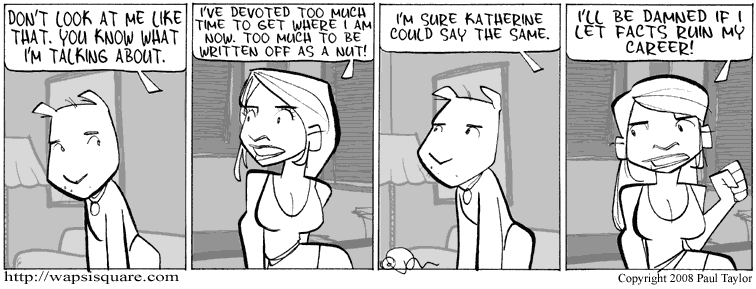



That last panel sounds like something a Politician would say.
It does indeed.
At least she didn’t say anything about alternative facts…
And we’re still dealing with this in my time. AAAAAAAAAHHHHHHHHHH!!!!!
Or a lawyer, or a police officer… some psychotherapists I could name…
Yes–she’s in the difficult position of being a voice crying in the wilderness: does she make the point that will exile her for years, or does she go with the flow and eventually become the unknown and forgotten person who might have pointed out a new discovery?
The real problem is that, in science, eventually the truth will surface. It may take a long, looooong time, but it will come.
And we will be very sorry that you were murdered for saying that doctors should wash their hands to prevent infection and death.
I’m not saying there might not be a greater good to the prophetic crying out–only that it’s a consideration when you realize something that sounds crackpot, and will get you branded and treated as a crackpot.
This is why I feel Gauss failed when he wrote to János Bolyai on his Non-Euclidean geometry in about 1832: “To praise it would amount to praising myself. For the entire content of the work…coincides almost exactly with my own meditations which have occupied my mind for the past thirty or thirty-five years.” Gauss, an established mathematician, had decades to publish, but chose not to do so–but when a newcomer did decide to risk everything and publish a radical, crackpot idea–the established expert claimed prior discovery. Not respectful.
She is probably going to have wait until some man comes to the same conclusion and publishes them. Then she’ll be vindicated and forgotten.
This is not how science is supposed to work. It may be part of the politics of science, but it isn’t how science works.
But it is how science works. And it’s always been like that. Galileo was persecuted for his theory that the world wasn’t the center of the universe. People don’t like changes that mess with their worldview. ESPECIALLY if it might possible contradict a religious “fact” (or something that might be perceived as a fact).
Finding the lost city of Atlantis or at least proving its (former) existence would be pretty cool and at least somewhat accepted by the world at large. Telling everyone it was destroyed by a supposedly-mythical creature will only damage your credibility, no matter how much proof you have.
*possibly
Oh, to have an edit button…
Galileo was vilified because he was a dick to the Pope who had been his friend.
A more current example
https://en.wikipedia.org/wiki/Alfred_Wegener
He was vilified by the geological science community for his theory of plate techtonics.
the world wasnt ready for that in 2008
its still not ready in 2011
we need a nice microwave style ‘bing’ to sound when we are ready ^^
As Darren would say, you need to make them come to your conclusion on their own, convince them it was their idea. Don’t tell them Atlantis was real, present the evidence but act confused by it. Present enough of it so that anyone educated in ancient history will think they can figure it out because they know so much more than you. Maybe even point out something that “proves” it can’t be from Atlantis, but put a major flaw in the argument that they will notice. That’s what I’d do.
Unfortunately, it doesn’t really work that way. Evidence, by definition, is something that supports a certain theory. Thus, you can’t present evidence to back up a theory, without presenting the theory itself. And even if you didn’t, the scientists you would be presenting it to, would most likely be bright enough to infer your theory from the evidence presented. Trying to then contradict this theory with obviously flawed arguments would most likely get you laughed out of the room.
OK, rereading in 2016, and I can’t stop seeing panel two as Hillary Clinton.
That is even worse now that the election has happened.
And it was STILL being contested NOW.
Luckily, the dems did a slow-motion self-destruct trying to impeach Trump.
then Pelosi basically obliterates any chance of the dems winning the oval office by trying to hijack the Covid-19 care package.
And thus a politician was born!!!😋