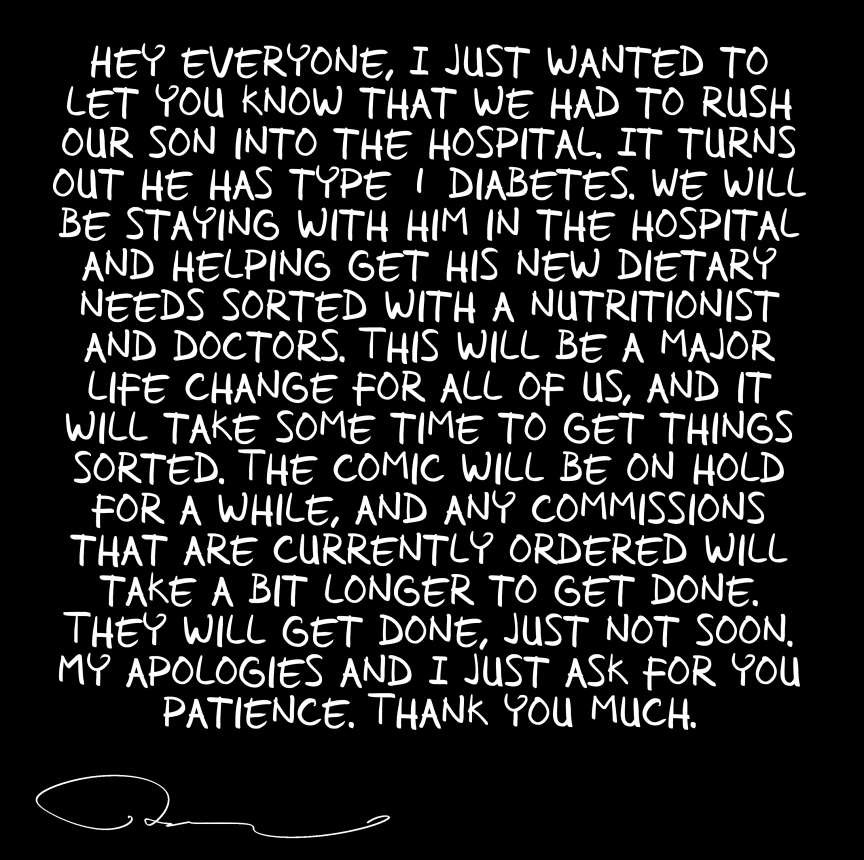



Hey everyone, I just wanted to let you know that we had to rush our son into the hospital. It turns out he has type 1 diabetes. We will be staying with him in the hospital and helping get his[…]↓ Read the rest of this entry…
Hey everyone, I just wanted to let you know that we had to rush our son into the hospital. It turns out he has type 1 diabetes. We will be staying with him in the hospital and helping get his[…]↓ Read the rest of this entry…
Discussion (25) ¬
-
That’s really rough. Take all the time you need.
-
What he said
-
-
so sorry to hear that, please take care of your family. ~<3
-
Good luck.
-
Real Life takes priority. Do what you need to do and us fans will still be here when you come back.
-
Being a Diabetic myself, I understand only too well. Give your Son all our best and take your time with the comic. We all wish your family well! 🙂
-
My son was diagnosed three years ago. Life changing event for all of us. It’s not the end of the world, though, for your son or you. It may take awhile, but he’ll be ok, and so will you. Be well and take care!
-
Totally understand that! Just know that we are here when everything is sorted!
-
Terribly sorry to hear this, Paul. Take care of him, take care of yourself.
-
Ouch.
All the best to your son and hoping for a quick adaptation to a new routine.
Take all the time you need, we’ll be here supporting you. -
Oh fudgecicles.
-
I can’t imagine what that put you all through. Best wishes for the best possible outcome of all this.
-
By my personal experience, he will get used to the insulin injections way faster than the limitations of the diet. Not eating, what you want or when you want it is hard to get used to. Or the other way around, when you are not hungry, yet you must eat something…
-
-
Ooph! No worries, Paul! My cousin had to deal with that last year! Take all the time you need, buddy! The kiddo’s definitely more important! We can wait! Let us know if there’s anything we can do to help!
-
May all that can bless you and your family – bless you, your family and the medical staff, and your efforts to help your son. Our hopes for the best are the winds at your back.
-
Scary moments for a kid, and the parents. Take all the time you need
-
First off I’m terribly sorry your family has to deal with this. My youngest sister was diagnosed with type one when she was two years old. Second: find a top shelf endocrinologist to guide you in this journey. My parents for years took my sister to a university of Texas hospital in Galveston Texas to learn what’s the newest thing there was at the time for diabetes mellitus.
-
Very sorry to hear about your son’s problem. I don’t personally know about it, but I understand it can be managed with proper care.
There is this new drug Teplizumab that can help some that are early in their Type 1 diabetes progression (stage 2) and are 8 years or older.
It can be expensive without insurance coverage for it, but you might be able to get payment assistance.
Talk to his doctor about it, if you wish to investigate.
See https://www.cdc.gov/diabetes/treatment/type-1-diabetes-early-treatment.html -
Oh my. Take care of your son and you and your family be well.
-
How is your son doing? I know diabetes is not an easy adjustment. Give your son an extra hug from all of us please.
-
Still a bit in shock and stressed but doing good. Thank you so much for checking. ^_^
-
-
Take your time. Real life comes first.
-
Yeah diabetes can be a major adjustment. It runs DEEP in my family.
-
Wow. I didn’t realize that type 1 can show itself when the patient is nearly grown. He is what, about 17 now? Either way, I hopenhe has an easy time adjusting to the changes. I can say that at least there are lots of current tech to help keep him on the safe path. My hopes go to you all.
-
He’s going to be 20. Apparently, type 1 can manifest up to age 30. =(
-


Comment ¬
Wapsi-Archive
4350 comics.

















That’s really rough. Take all the time you need.
What he said
so sorry to hear that, please take care of your family. ~<3
Good luck.
Real Life takes priority. Do what you need to do and us fans will still be here when you come back.
Being a Diabetic myself, I understand only too well. Give your Son all our best and take your time with the comic. We all wish your family well! 🙂
My son was diagnosed three years ago. Life changing event for all of us. It’s not the end of the world, though, for your son or you. It may take awhile, but he’ll be ok, and so will you. Be well and take care!
Totally understand that! Just know that we are here when everything is sorted!
Terribly sorry to hear this, Paul. Take care of him, take care of yourself.
Ouch.
All the best to your son and hoping for a quick adaptation to a new routine.
Take all the time you need, we’ll be here supporting you.
Oh fudgecicles.
I can’t imagine what that put you all through. Best wishes for the best possible outcome of all this.
By my personal experience, he will get used to the insulin injections way faster than the limitations of the diet. Not eating, what you want or when you want it is hard to get used to. Or the other way around, when you are not hungry, yet you must eat something…
Ooph! No worries, Paul! My cousin had to deal with that last year! Take all the time you need, buddy! The kiddo’s definitely more important! We can wait! Let us know if there’s anything we can do to help!
May all that can bless you and your family – bless you, your family and the medical staff, and your efforts to help your son. Our hopes for the best are the winds at your back.
Scary moments for a kid, and the parents. Take all the time you need
First off I’m terribly sorry your family has to deal with this. My youngest sister was diagnosed with type one when she was two years old. Second: find a top shelf endocrinologist to guide you in this journey. My parents for years took my sister to a university of Texas hospital in Galveston Texas to learn what’s the newest thing there was at the time for diabetes mellitus.
Very sorry to hear about your son’s problem. I don’t personally know about it, but I understand it can be managed with proper care.
There is this new drug Teplizumab that can help some that are early in their Type 1 diabetes progression (stage 2) and are 8 years or older.
It can be expensive without insurance coverage for it, but you might be able to get payment assistance.
Talk to his doctor about it, if you wish to investigate.
See https://www.cdc.gov/diabetes/treatment/type-1-diabetes-early-treatment.html
Oh my. Take care of your son and you and your family be well.
How is your son doing? I know diabetes is not an easy adjustment. Give your son an extra hug from all of us please.
Still a bit in shock and stressed but doing good. Thank you so much for checking. ^_^
Take your time. Real life comes first.
Yeah diabetes can be a major adjustment. It runs DEEP in my family.
Wow. I didn’t realize that type 1 can show itself when the patient is nearly grown. He is what, about 17 now? Either way, I hopenhe has an easy time adjusting to the changes. I can say that at least there are lots of current tech to help keep him on the safe path. My hopes go to you all.
He’s going to be 20. Apparently, type 1 can manifest up to age 30. =(